
Regenerative Medicine
PRP, platelet-rich plasma: what it is and when it may help.
PRP is a small quantity of your own plasma with a higher concentration of platelets than blood. It is obtained from an ordinary blood sample, prepared using a centrifuge and applied to the area to be treated: skin, joint, tendon or wound.
At Palazzo Manzoni, in Brescia, PRP is part of the regenerative medicine service of the plastic surgery department and is offered only after a diagnosis, when the scientific evidence for that problem justifies it. In some areas the evidence is more robust, in others the results are uncertain: we tell you beforehand, not afterwards.
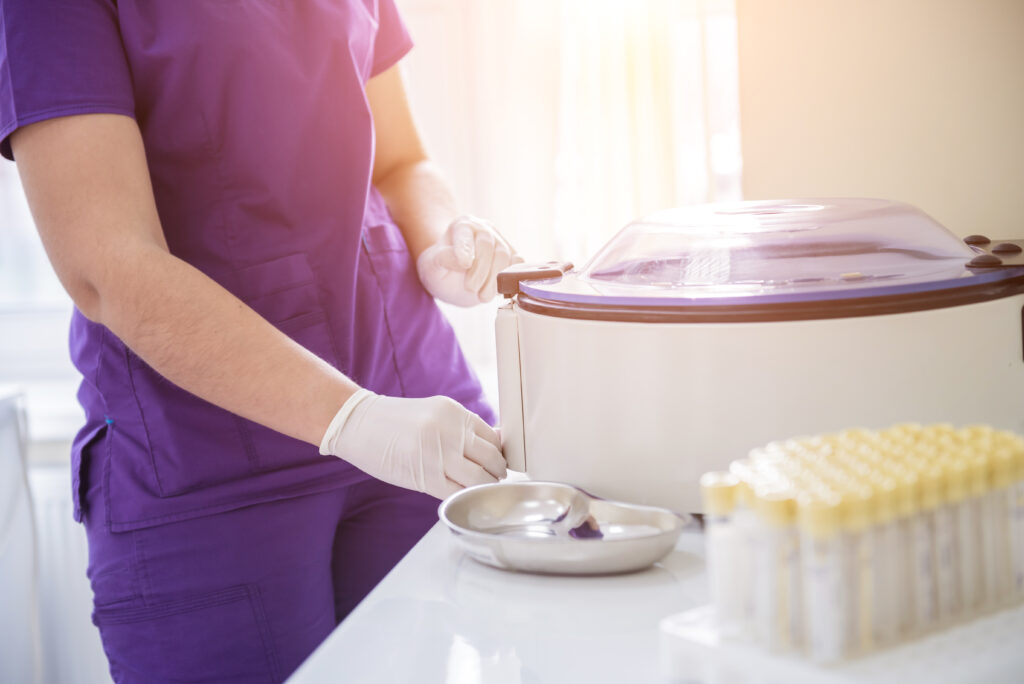
From your blood
A blood sample, a centrifuge, a platelet concentrate
At least 3 times
The reference platelet concentration indicated in Italy
Same appointment
Blood sample, preparation and application in the same session
Precise rules
In Italy, PRP is a blood component regulated by law
How It Works
Platelets do more than stop bleeding.
When we cut ourselves, platelets are the first to arrive. As well as forming the plug that stops the bleeding, they release growth factors and other molecules that attract cells, modulate inflammation and promote the formation of new small blood vessels. PRP tries to harness this mechanism by concentrating it where it is needed.
The preparation is simple: a small amount of blood is drawn and centrifuged, and the plasma fraction richest in platelets is separated. The preparation is then injected into the area to be treated; in joints and tendons, when necessary, this is done under ultrasound guidance, to see in real time where the needle is going.
Not all PRP is the same. There are preparations that are poor or rich in white blood cells, in liquid form or as a fibrin gel, and different preparation systems produce concentrates that differ greatly from one another. This is one of the reasons why studies give variable results, and why it matters who prepares it and how.
Did you know?
PRP has a long history in the operating theatre. As early as 1987 it was being prepared in cardiac surgery to avoid donor transfusions, and in 1998 a group of oral and maxillofacial surgeons at the University of Miami added it to mandibular bone grafts: the platelet concentration reached 338% and, on X-rays, the grafts matured 1.62 to 2.16 times faster.
Sources: Ferrari M et al., International Journal of Artificial Organs 1987; Marx RE et al., Oral Surgery, Oral Medicine, Oral Pathology, Oral Radiology and Endodontics 1998
Where It Is Used
PRP in the different areas of regenerative medicine
The same preparation has very different uses. The site, the technique, the number of sessions and, above all, the strength of the available scientific evidence all vary.
That is why at Palazzo Manzoni each area has its own specialist: PRP is not a treatment in its own right, but a tool within a care pathway.

01
Face and skin quality
Skin texture, elasticity and thickness, on its own or together with fractional laser and microneedling. Aesthetic regenerative medicine
02
Scars
Mainly atrophic acne scars, in combination with fractional laser. Scars
03
Knee and joints
Early or intermediate knee osteoarthritis, with orthopaedic specialist Dr. Claudio Gilardoni. PRP for the knee
04
Tendons and shoulder
Some chronic tendinopathies and the shoulder, with results that differ from tendon to tendon. Regenerative medicine in orthopaedics
05
Temporomandibular joint
After joint lavage, in selected patients, with Dr. Luana Salvagni. The TMJ
06
Ulcers and hard-to-heal wounds
Only after the vascular cause has been treated, with Prof. Edoardo Cervi. Ulcers and wounds
What the Research Says
Where the evidence is solid, and where it is not
PRP is one of the most studied treatments in regenerative medicine, but the quality of the studies varies widely. Here, in brief, is what we know today.
→Knee osteoarthritis
In a meta-analysis of 18 randomised trials, the average improvement was greater with PRP (44.7%) than with hyaluronic acid (12.6%), but in the large placebo-controlled RESTORE trial (288 patients) there was no difference at 12 months. Guidance from the Italian National Blood Centre (Centro Nazionale Sangue) recommends it for grade 1-3 osteoarthritis. Belk 2021; Bennell 2021
→Facial skin
A review of 24 studies describes a modest improvement, at least temporary, mainly in texture, with protocols that differ widely from one another. Maisel-Campbell 2019
→Acne scars
In a meta-analysis of 11 randomised trials, adding PRP to fractional CO2 laser gave better results than laser alone. Aljefri 2022
→Tendons
For the Achilles tendon, two studies published in JAMA showed no benefit compared with placebo; for tennis elbow, PRP did not outperform placebo, while compared with cortisone it gives better results beyond 6 months (cortisone helps more in the first few weeks). de Vos 2010; Kearney 2021; Antunes Júnior 2026; Maroun 2025
→Diabetic foot ulcers
A Cochrane review concludes that PRP might improve healing, but on the basis of only two small studies; for venous leg ulcers the effect is unclear. Martinez-Zapata 2016
The honest message: PRP can help in selected situations, it is not a universal remedy and it does not replace treating the cause.
Your Journey
How treatment with PRP works
Step 01
The consultation
The specialist for the relevant area examines you, reviews your tests and decides whether PRP has a genuine indication or whether there is a better option.
Step 02
The blood sample
An ordinary venous blood sample, in a quantity suited to the area to be treated.
Step 03
The preparation
The blood is centrifuged to separate the plasma fraction richest in platelets, ready for use.
Step 04
The application
Injection into the area to be treated, under ultrasound guidance when needed, or application to the skin or the wound.
Step 05
Check-ups
Improvement, when it occurs, is gradual. At check-ups we assess the response and decide whether to continue, complete the course or change approach.
Frequently Asked Questions
Frequently asked questions
about PRP
What is PRP?
PRP stands for platelet-rich plasma. It is a fraction of your plasma with a higher concentration of platelets than blood, obtained with a centrifuge from an ordinary blood sample. Platelets contain growth factors and other molecules that take part in tissue repair.
How is PRP prepared?
A small amount of blood is drawn and centrifuged, and the part of the plasma richest in platelets is separated. According to the guidance of the Italian National Blood Centre (Centro Nazionale Sangue), the preparation must have a platelet concentration at least 3 times that of the patient’s blood. Everything takes place in the same session.
Is PRP safe?
Because it is autologous, meaning it is obtained from your own blood, it carries no risk of rejection. It is not, however, free of side effects: in a meta-analysis of 24 studies on the knee, complications were more frequent than with placebo, but similar to those of hyaluronic acid and cortisone, and generally mild and short-lived, such as pain or swelling at the injection site.
How many PRP injections are needed?
There is no single protocol. It depends on the area, the problem and the preparation. For knee osteoarthritis, the Italian guidance refers to a course of 3 applications; for other indications, the number is decided case by case. You will find it written in the plan we give you after the consultation.
How long does it take to work?
PRP is not a fast-acting painkiller. When it works, the improvement is gradual and becomes noticeable over the following weeks. That is why check-ups are scheduled at intervals and help us decide whether to continue.
Who cannot have PRP?
Some conditions may make it inadvisable, for example clotting disorders or an infection in the area to be treated. That is why the consultation and, when needed, blood tests come before treatment. Please bring a list of the medicines you take to your consultation.
PRP or hyaluronic acid: what is the difference?
They are not the same thing, and one does not necessarily have to replace the other. Hyaluronic acid has been used for many years in injections for osteoarthritis; PRP uses biological components of your own blood. The choice depends on the joint, the grade of osteoarthritis and the goals: in some cases, sequential strategies are considered.
Is PRP regulated by law?
Yes. In Italy, PRP is a blood component for non-transfusion use and is governed by the Ministry of Health decree of 2 November 2015 and subsequent amendments, which sets requirements for quality, traceability and informed consent. Outside the transfusion service, it may only be prepared in authorised healthcare facilities, under an agreement with the reference transfusion service. Palazzo Manzoni operates under such an agreement with the transfusion service.
Can a competitive athlete have PRP?
Yes: since 2011 the World Anti-Doping Agency has permitted the use of autologous PRP in competitive sport, because there is no evidence that it enhances performance. Before a competition, however, it is good practice to inform your sports federation’s doctor.
How much does PRP cost?
The cost depends on the area to be treated, the type of preparation and the number of sessions. After the consultation you will receive a detailed written quote.
Take the Next Step
Your next step starts
with a conversation
At Palazzo Manzoni in Brescia, every consultation is personal, unhurried, and designed to give you clarity about your next step.
Address
Via dei Mille 14, 25122 Brescia, Italia
Phone
Hours
Mon-Fri 8:30-18:30 · Sat 9:00-13:00
01
Get in touch
Call, email, WhatsApp, or book online.
02
Meet your specialist
A personal consultation to understand your situation.
03
Your plan, your pace
Together you decide the best path forward.



Content reviewed by Dr. Stefano Di Nonno, Dr. Luana Salvagni, Dr. Claudio Gilardoni and Prof. Edoardo Cervi, the regenerative medicine team at Palazzo Manzoni.