
Regenerative Medicine · Vascular Surgery
Ulcers and hard-to-heal wounds in Brescia: circulation first, then regeneration.
A wound that does not heal is not always just a skin problem. In leg ulcers and chronic wounds, difficulty healing may depend on the circulation, poor oxygenation of the tissues, inflammation that does not settle or a disruption of the normal repair mechanisms.
At Palazzo Manzoni the care pathway is led by Prof. Edoardo Cervi, vascular surgeon and head of the department of vascular surgery and phlebology. PRP, platelet gel and other biological strategies may have a role, but only within a precise sequence: vascular diagnosis, treatment of the cause, local wound care and, finally, any regenerative therapies.
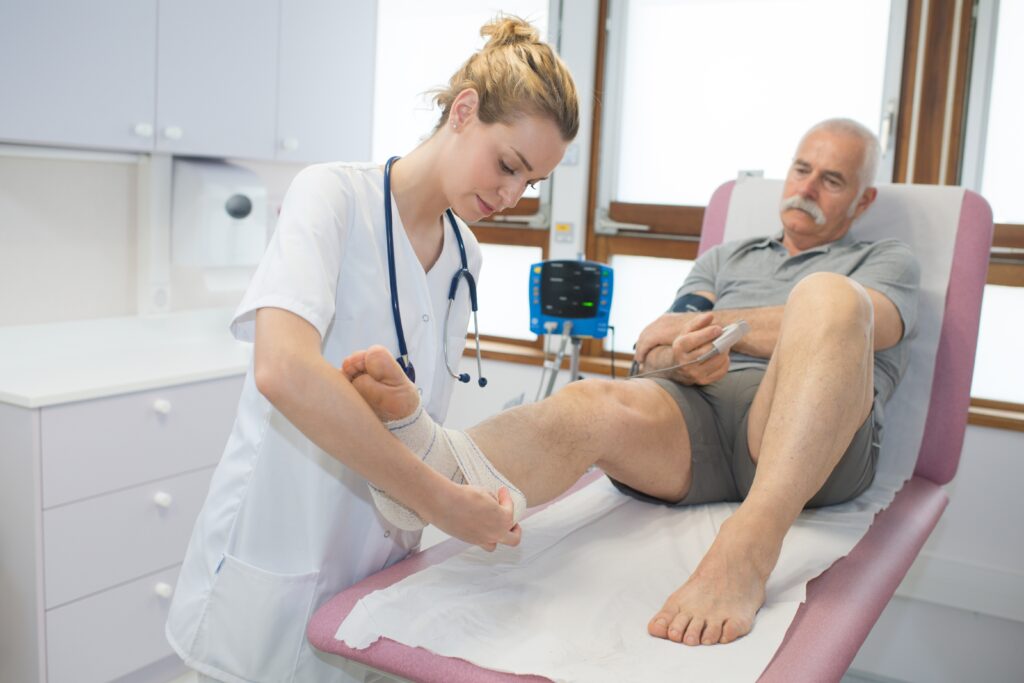
Cause first
Duplex ultrasound and assessment of the circulation
56 versus 82 days
Median healing time in the EVRA study when diseased veins were treated straight away
Compression
The cornerstone of venous leg ulcer care
Biology afterwards
PRP and platelet concentrates in selected cases
Chronic Wounds
Why do some wounds not heal?
Wound healing is a complex biological process: it requires a good supply of blood and oxygen, the formation of new small vessels, control of inflammation and the coordinated work of many cells. A wound is defined as chronic when it does not pass through these phases in the expected time, and it often remains stuck in the inflammatory phase.
This can happen with chronic venous insufficiency, peripheral arterial disease, diabetes, disorders of the microcirculation, persistent oedema, infection or a reduced capacity for tissue repair. Several factors often coexist in the same person.
That is why the first step is not to treat the wound, but to understand its cause. A venous leg ulcer, an arterial ulcer and a diabetic foot ulcer can look alike, but they are treated differently.
Did you know?
In 1885 the German dermatologist Paul Gerson Unna invented, for varicose ulcers, a gauze bandage impregnated with a zinc oxide paste, as an alternative to the poorly tolerated compression bandages of his time. Versions of what is still called the “Unna boot” are used to this day for chronic venous leg ulcers.
Source: Tekiner H, Karamanou M, Acta Dermatovenerologica Croatica 2019
The Right Sequence
Diagnosis, cause, wound, and only then biology
Regenerative medicine does not replace treatment of the vascular disease that caused the ulcer. It is this integration, more than any single procedure, that determines the quality of care.
Vascular diagnosis, treatment of the cause, local wound management, possible use of regenerative strategies: in that order.

01
Vascular diagnosis
Venous and arterial duplex ultrasound and assessment of the pulses and ankle pressure: to understand whether the problem is venous, arterial or mixed.
02
Venous leg ulcer: pressure in the veins
Compression with suitable bandages or garments, at least 40 mmHg at the ankle according to European guidelines, and early treatment of the diseased superficial veins.
03
Ischaemia: blood first
If the limb receives too little blood, the priority is to assess revascularisation: an ischaemic wound needs circulation above all.
04
Diabetic foot: a team effort
Offloading, control of infection and blood sugar, wound cleansing and vascular assessment: about half of people with a diabetic foot ulcer also have arterial disease.
05
Local care and biological therapies
Debridement, appropriate dressings and, when standard care is not enough, platelet concentrates or other regenerative strategies in selected cases.
What the Research Says
Ulcers and regenerative therapies: the evidence in brief
Some applications have already entered clinical practice in selected settings; others remain mainly a subject of research. Here is what we know.
→Treating the veins early
In the EVRA study (450 patients), early endovenous ablation of the superficial veins, together with compression, healed venous leg ulcers in a median time of 56 days versus 82, with fewer recurrences over time. Gohel 2018; Gohel 2020
→PRP and ulcers
According to a Cochrane review, PRP might improve the healing of diabetic foot ulcers, but on the basis of only two small studies; for venous leg ulcers the effect is unclear. Martinez-Zapata 2016
→The platelet and fibrin patch
In 269 people with hard-to-heal diabetic foot ulcers, a disc of leucocytes, platelets and fibrin obtained from the patient’s own blood led to healing of 34% of ulcers at 20 weeks, compared with 22% with standard care alone. Game 2018
→Diabetic foot guidelines
The 2023 IWGDF international guidelines suggest considering this patch only when the best standard care has not worked, and not using other platelet-based therapies in addition to standard care for the diabetic foot. IWGDF 2023
→Cell therapies and ischaemia
In critical limb ischaemia, a meta-analysis of placebo-controlled studies showed no benefit of cell therapies on amputation and survival, and a Cochrane review judges the evidence to be of low or very low certainty: vascular guidelines reserve these therapies for clinical trials. Peeters Weem 2015; Moazzami 2022; Conte 2019
The principle remains simple: there is no effective regeneration without a correct diagnosis of the cause that is preventing the tissue from healing.
Food for Thought
Can they grow new blood vessels?
Stimulating the formation of new vessels, so-called therapeutic angiogenesis, is one of the most fascinating fields of vascular regenerative medicine. Bone marrow cells, mesenchymal cells from adipose tissue and various biological factors have been studied to improve the blood supply to ischaemic tissues.
This is, however, a field in which research must be carefully distinguished from established treatment: cell therapies are not an equivalent alternative to revascularisation. The future will probably not be a single “regenerative therapy”, but the integration of vascular diagnostics, revascularisation, wound care and biological medicine, in a pathway built around each patient.
There is also a new way of looking at these wounds. Diabetic foot ulcers often come back: about 40% within one year and 65% within five years. That is why some experts propose regarding someone whose wound has closed as a person “in remission” rather than healed, and continuing to protect the foot (Armstrong 2017).
Did you know?
Regenerative wound medicine has deep roots: as early as 1986 a group of researchers treated 49 patients with chronic skin ulcers using healing factors derived from their own platelets, presenting this as the first clinical demonstration that growth factors applied to a wound promote its healing.
Who Leads Your Care
Prof. Edoardo Cervi
Vascular surgeon and head of the department of vascular surgery and phlebology at Palazzo Manzoni. In the regenerative medicine division he is responsible for the vascular side: lower limb ulcers and hard-to-heal wounds.
Training
general and vascular surgeon with specialist training in phlebology
Diagnostics
venous and arterial duplex ultrasound as the basis of every decision
Research
scientific work indexed on PubMed and ORCID, with an affiliation to the University of Brescia
Outreach
video interview “Le ulcere agli arti inferiori” (lower limb ulcers), Medicina365, 2020
Your Journey
How an ulcer is treated, step by step
Step 01
The vascular consultation
History of the wound, examination of the leg and foot, duplex ultrasound: to understand the cause and how much blood reaches the tissues.
Step 02
Treating the cause
Compression and treatment of the veins for a venous leg ulcer; assessment for revascularisation if the arterial circulation is insufficient.
Step 03
Wound care
Cleansing, suitable dressings, offloading for the diabetic foot and infection control, in collaboration with your GP and the other specialists.
Step 04
Biological therapies
If the wound does not improve despite correct standard care, the use of PRP or platelet concentrates is considered in selected cases.
Step 05
Preventing recurrence
After healing: long-term compression, care of the veins, protection of the foot and regular check-ups.
Frequently Asked Questions
Frequently asked questions
about ulcers and hard-to-heal wounds
Why does a wound fail to heal?
The most common causes are problems with the venous or arterial circulation, diabetes, oedema, infection and inflammation that does not settle. Several factors often coexist. That is why a wound that is not improving should always be assessed by a specialist, starting with the circulation.
What is a venous leg ulcer?
It is a wound on the leg, usually near the ankle, caused by high pressure in the veins: blood pools, the skin becomes damaged and eventually breaks open. Venous disease is the most common cause of leg ulcers. It is treated with compression and, when possible, by treating the diseased superficial veins.
Can PRP heal an ulcer?
It may help in selected patients, but on its own it cannot make up for severe circulatory insufficiency. According to the Cochrane review, PRP might promote the healing of diabetic foot ulcers, with low-quality evidence; for venous leg ulcers the effect is unclear.
What is platelet gel?
It is a platelet concentrate obtained from the patient’s blood and applied to the wound as a gel, with the aim of delivering to the tissue growth factors involved in repair. It is used in addition to standard care, not instead of it; for the diabetic foot, however, the 2023 IWGDF guidelines suggest not using platelet concentrates other than the leucocyte, platelet and fibrin patch, and for venous leg ulcers the effect is unclear.
What should be done for a diabetic foot ulcer?
A multidisciplinary approach is needed: offloading the ulcer area, cleansing the wound, controlling infection and blood sugar, and vascular assessment, because about half of patients also have arterial disease. If the wound shrinks by less than 50% in 4 weeks despite correct care, guidelines advise reassessing the circulation with a vascular specialist.
Is compression really necessary?
For a venous leg ulcer, yes: compression bandages or stockings probably help more people heal, and heal faster, and they reduce pain. European guidelines recommend at least 40 mmHg at the ankle. Before compression, however, significant arterial disease must be ruled out.
Is a procedure on the veins needed?
It is often helpful: treating the diseased superficial veins early with endovenous techniques, together with compression, speeds up the healing of venous leg ulcers and reduces recurrence. Prof. Cervi uses duplex ultrasound to assess whether and how to intervene.
How long does healing take?
It depends on the cause, the size of the wound and how early the cause is treated. In the EVRA study, the median healing time for venous leg ulcers was 56 days with early treatment of the veins. For the diabetic foot, healing times are often longer.
How much does the care pathway cost?
It depends on the tests and treatments needed. After the vascular consultation you will receive a detailed written quote.
Take the Next Step
Your next step starts
with a conversation
At Palazzo Manzoni in Brescia, every consultation is personal, unhurried, and designed to give you clarity about your next step.
Address
Via dei Mille 14, 25122 Brescia, Italia
Phone
Hours
Mon-Fri 8:30-18:30 · Sat 9:00-13:00
01
Get in touch
Call, email, WhatsApp, or book online.
02
Meet your specialist
A personal consultation to understand your situation.
03
Your plan, your pace
Together you decide the best path forward.

Content reviewed by Prof. Edoardo Cervi, head of Vascular Surgery.