
Regenerative Medicine
Scars in Brescia: when regenerative medicine can help.
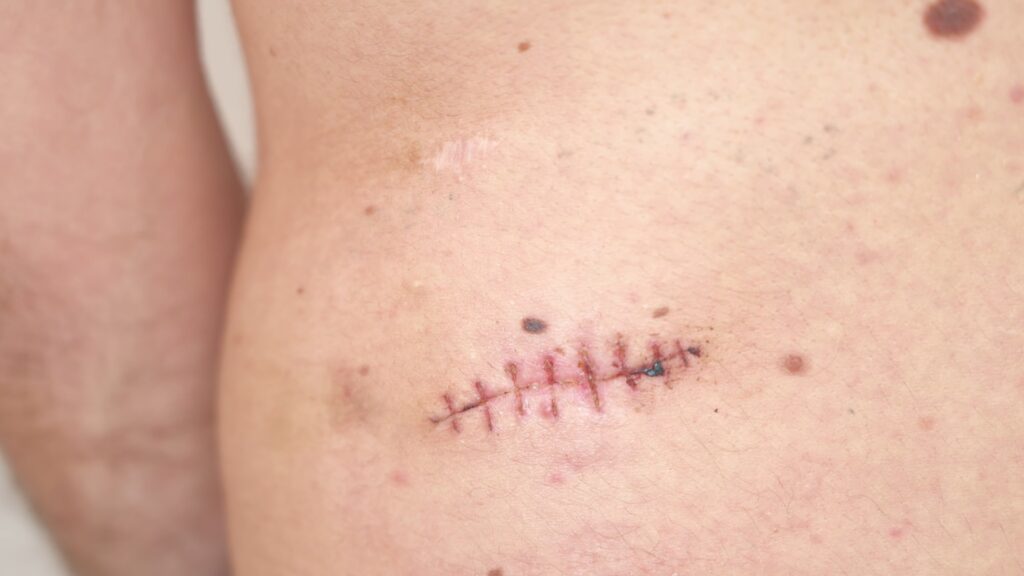
A scar is not just a mark on the surface of the skin: it is the result of a complex biological repair process. When it is stiff, retracted, painful or uneven, lipofilling, nanofat and PRP may improve its characteristics in selected patients.
At Palazzo Manzoni, scars are assessed within the plastic surgery department, where Dr. Luana Salvagni and Dr. Stefano Di Nonno handle scar revision. Regenerative medicine can complement, or sometimes replace, surgical correction: the choice depends on the type of scar.
Improving, not erasing
Realistic goals for texture, colour and adhesions
Combined strategies
Lipofilling, PRP, fractional laser and surgery
Autologous tissue
The fat and plasma come from the patient themselves
The right timing
A scar matures over 12-18 months, sometimes longer
Scars
Every scar tells the story of a repair process.
After a wound, an operation or a burn, the body repairs the tissue through a complex process that does not recreate the original skin but forms a new tissue, richer in collagen and less elastic. Sometimes the result is a thin, flat line; at other times the scar becomes sunken, thickens, shortens or adheres to the deeper layers.
Hypertrophic scars and keloids are, in both cases, “excess” scars. The difference is that a keloid extends beyond the margins of the original wound and does not tend to regress on its own; it can appear after operations, injuries or even minor injuries in predisposed people. Atrophic scars, such as acne scars, are instead depressions in the skin.
Recognising the type of scar is essential: it changes the treatment, the timescales and the results that can reasonably be expected.
Did you know?
In the early stages of pregnancy, wounds to the skin of the foetus heal quickly and without leaving a scar, unlike those of adults. Despite decades of research, the exact mechanism is still largely unknown: understanding it is one of the goals of regenerative medicine.
Source: Larson BJ et al., Plastic and Reconstructive Surgery 2010
What Can Be Improved
The goals of a regenerative scar treatment
PRP, lipofilling and preparations derived from adipose tissue are being studied as ways to improve, in selected patients, certain characteristics of a scar. They do not erase it: more often, they make it softer, more elastic and less visible.
Goals are set during the consultation, by looking at and touching the scar, and by asking you what bothers you: its appearance, tightness, pain or movement.

01
Elasticity and texture
A softer, less stiff scar: this is the best-documented effect of lipofilling in studies.
02
Adhesion to the deeper layers
Scars that “pull” or move with the underlying tissues can be released and treated with fat.
03
Skin quality
Thickness, texture and evenness of the scarred skin and of the surrounding skin.
04
Irregularities and depressions
Sunken scars, such as some acne scars or post-traumatic scars.
05
Colour and tissues after surgery or trauma
Some changes in colour and the quality of the tissues in areas that have already been operated on or injured, with results that vary from person to person.
The Options
Strategies that are often combined
Regenerative medicine can be combined with other methods, such as fractional lasers, microneedling or surgical scar revision. The right sequence depends on the type of scar, its location and the skin.
→Lipofilling and nanofat
small grafts of autologous fat (from the patient’s own body) beneath the scar or within it, to make it softer, fill depressions and release adhesions. Microfat and nanofat
→PRP and fractional laser
the laser stimulates skin renewal in a controlled way and PRP is applied to support the tissue’s response: for acne scars this is one of the most studied combinations, with favourable results in several meta-analyses but not in all of them. PRP
→Microneedling
regular micro-perforations of the skin, alone or combined with other substances, for some atrophic scars.
→Surgical revision
when the scar is wide, retracted or in an unfavourable position, surgical correction often remains the most effective solution, possibly completed by a regenerative treatment. Dermatological surgery
Keloids and hypertrophic scars in an active phase require a specific assessment: not all treatments are suitable, and some may make them worse.
What the Research Says
The evidence, in brief
→Lipofilling
A meta-analysis of 45 studies and more than 3,000 patients found an improvement in scars, particularly in stiffness and elasticity; on average 1.4 sessions were needed, and the rate of minor complications was 4.8%. Krastev 2020
→Retractile and painful scars
In a case series from Milan, the areas treated with autologous fat were found to be less hard than those injected with saline, with improvements rated by both doctors and patients. Klinger 2013
→Nanofat
In a double-blind randomised study of 50 abdominoplasty scars, the half treated with nanofat was better at 6 months; however, the benefits beyond 12 months remain uncertain. Wongkietkachorn 2025; Al-Sabri 2025
→Acne scars
In a meta-analysis of 11 randomised studies, adding PRP to fractional CO2 laser gave greater improvement and higher satisfaction than laser alone. Aljefri 2022
→After a burn
Hypertrophic scars are common: in a review of 48 articles, their prevalence ranged from 32% to 72%. Lawrence 2012
Food for Thought
Why do we scar while other animals regenerate?
Adult humans repair wounds by “closing” them quickly with a scar: a fast solution, useful for survival, but one that sacrifices the original shape and elasticity. Regenerative medicine tries, on a small scale, to shift the balance away from scarring and towards regeneration.
It is an ambitious goal and still a distant one. But every time a scar becomes softer, less tight and less visible, it is a step in that direction.
Did you know?
The African spiny mouse (Acomys) can lose patches of skin to escape predators and then regenerate it. In holes in its ears, it completely rebuilds hair follicles, sebaceous glands, dermis and cartilage: for researchers, it may help to understand how to promote regeneration in place of scarring.
Source: Seifert AW et al., Nature 2012
Who Takes Care of You
Scar revision
at Palazzo Manzoni
Scars are assessed in the plastic surgery department, where dermatological surgery and regenerative medicine work together. At the first consultation, you and the specialist decide whether you need a regenerative treatment, a surgical correction or both.

Dr. Luana Salvagni
Specialist in Maxillofacial Surgery · facial dermatological surgery, scar revision.

Dr. Stefano Di Nonno
Specialist in General Surgery, with a master’s degree in Aesthetic Surgery · scar revision, harvesting and preparation of adipose tissue.
Your Journey
How we approach a scar, in Brescia
Step 01
The consultation
We look at and feel the scar, and assess its age, type, location and symptoms, with photographic documentation.
Step 02
The right time
A scar generally keeps changing for 12-18 months, sometimes longer: it is often best to wait for it to mature before treating it.
Step 03
The plan
The method or combination of methods, the number of sessions and realistic results, in writing.
Step 04
The treatment
As an outpatient procedure or in the operating theatre, depending on the technique: lipofilling requires a small fat harvest in the same session.
Step 05
Follow-up
Improvement is gradual: at follow-up visits we assess the response and whether an additional session is needed.
Frequently Asked Questions
Frequently asked questions
about scar treatment
Can a scar be removed completely?
Generally not: a scar is a different tissue from the original skin, and no treatment erases it. However, it can often be improved, making it softer, less raised or sunken, less tight and less visible. The realistic goal is defined during the consultation.
What are hypertrophic scars?
They are thick, raised scars that stay within the margins of the original wound and may fade over time. They are common after burns and in certain locations. They should be distinguished from keloids, which instead extend beyond the margins of the wound and do not tend to regress.
What is the difference between a hypertrophic scar and a keloid?
In both cases these are excess scars, but a keloid extends beyond the edges of the wound and does not regress spontaneously; it can appear even after minor injuries in predisposed people. The distinction is important because it changes the treatment.
When is the best time to treat a scar?
A scar generally matures over 12-18 months, sometimes longer: during this period its colour, texture and thickness change. Some treatments are best carried out once the scar has matured, while others can begin earlier. We assess this during the consultation, case by case.
Does lipofilling work on scars?
Studies indicate an improvement particularly in stiffness and elasticity, with results perceived by both doctors and patients. A meta-analysis of 45 studies reports an average of 1.4 sessions to achieve the desired result and minor complications in 4.8% of procedures.
Does PRP help with acne scars?
In a meta-analysis of 11 randomised studies, PRP combined with fractional CO2 laser gave better results on atrophic acne scars than laser alone. On its own, or with other techniques, the data are less clear.
Is surgery always necessary?
No. Many scars improve with regenerative treatments or with laser; others, which are wide, retracted or in an unfavourable position, are better corrected with surgical revision, possibly completed by a regenerative treatment.
How much does scar treatment cost?
It depends on the type of scar, its extent and the technique chosen. After the consultation you will receive a detailed written quote.
Take the Next Step
Your next step starts
with a conversation
At Palazzo Manzoni in Brescia, every consultation is personal, unhurried, and designed to give you clarity about your next step.
Address
Via dei Mille 14, 25122 Brescia, Italia
Phone
Hours
Mon-Fri 8:30-18:30 · Sat 9:00-13:00
01
Get in touch
Call, email, WhatsApp, or book online.
02
Meet your specialist
A personal consultation to understand your situation.
03
Your plan, your pace
Together you decide the best path forward.


Content reviewed by Dr. Luana Salvagni and Dr. Stefano Di Nonno.