
Regenerative Medicine
Fat grafting (lipofilling), microfat and nanofat in Brescia: your own fat as a resource.
Fat grafting (lipofilling) is the grafting of autologous adipose (fat) tissue, meaning tissue taken from the same person. For years it was used mainly to restore volume; today we know that fat is a biologically complex tissue, and it is also being studied for its effects on the quality of skin and scars.
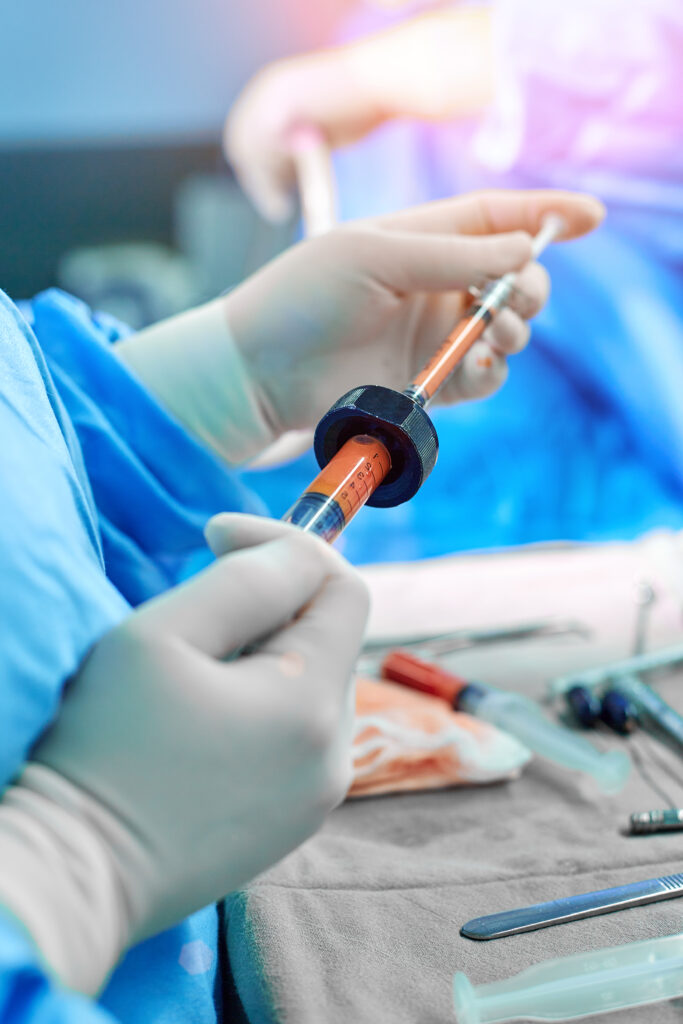
At Palazzo Manzoni, the harvesting and preparation of adipose tissue are entrusted to Dr. Stefano Di Nonno, within the regenerative medicine division of the plastic surgery department. Depending on the goal, the fat is prepared as microfat, for volume, or as nanofat, for tissue quality.
Autologous
No foreign material: the fat comes from you
Two preparations
Microfat for volume, nanofat for skin quality
Same session
Harvesting, preparation and grafting in the same procedure
Day procedure
Local anaesthetic, possibly with sedation
Adipose Tissue
Not just a natural filler.
Traditionally, fat has been used to fill: a hollow cheek, a sunken temple, the after-effects of surgery. But adipose tissue contains much more than fat cells: extracellular matrix, small blood vessels and various cell populations, including stromal cells with mesenchymal characteristics.
These cells appear to act mainly through a paracrine mechanism, that is, by communicating with nearby cells through growth factors, cytokines and other molecules. That is why fat grafting is no longer studied only as a volumising technique, but also for its possible effects on the tissues into which it is transferred.
This observation gave rise to different fat-processing techniques, including microfat and nanofat. They are not the same thing and do not serve the same purpose: understanding the difference is the first step towards choosing well.
Did you know?
The first free fat graft is traced back to 1893: the surgeon Neuber used small “pearls” of fat taken from the arm to fill depressed scars on the face, left by an injury involving loss of the underlying bone.
Microfat and Nanofat
What is the difference between microfat and nanofat?
Not all preparations derived from adipose tissue have the same function. The way the fat is harvested and processed changes what it contains, and therefore what it can do.
The choice is made at the consultation, based on what you want to improve: volume, skin quality or both.

Did you know?
Fat injections emerged empirically about a hundred years ago, mainly for the face and breast. To prevent the fat from being reabsorbed, the German surgeon Eugene Hollaender (1867-1932) even proposed a “cocktail” of human fat and mutton fat.
Source: Mazzola RF, Mazzola IC, Clinics in Plastic Surgery 2015
01
The harvest
The fat is harvested with fine cannulas, usually from the abdomen, flanks or thighs, through incisions a few millimetres long.
02
Microfat
Fat harvested with fine multi-hole cannulas, which retains a viable adipose component: it is used when volume also needs to be restored.
03
Nanofat
Microfat is emulsified and filtered until it is fluid enough to pass through very fine needles, as fine as 27 gauge. It loses most of its volumising function but retains stromal components and active molecules.
04
What nanofat is used for
In the original description it contained no living fat cells, while stromal cells were still abundant: that is why it is intended for thin skin, fine lines, dark under-eye circles and some scars, rather than for volume.
05
How much of it remains
Not all grafted fat survives: in a meta-analysis of 31 studies on the face, at 12 months about 43% remained in atrophic deformities and 64% in mixed ones.
What the Research Says
The evidence on regenerative fat grafting, in brief
Volumetric fat grafting is an established technique. Its effects on tissue quality are a more recent finding and the studies are of variable quality: here is what we know.
→Nanofat for the skin
In the original series of 67 cases, the authors observed marked improvements in skin quality at 6 months, with no infections, cysts or granulomas. A 2023 review confirms potential benefits but rates the quality of the evidence as low. Tonnard 2013; Tran 2023
→Nanofat for scars
In a randomised double-blind study of 50 abdominoplasty scars, the half treated with nanofat showed a better result at 6 months. However, two high-quality studies did not show benefits maintained beyond 12 months. Wongkietkachorn 2025; Al-Sabri 2025
→Fat grafting for scars
A meta-analysis of 45 studies and over 3,000 patients found an improvement mainly in stiffness and elasticity, with an average of 1.4 sessions and minor complications in 4.8% of procedures. Krastev 2020
→Damaged tissues
In 2007 a group from Verona used fat grafts to treat 20 patients with severe radiotherapy damage, observing improved symptoms and new small blood vessels in the treated tissues. It is a small case series: an interesting signal rather than proof. Rigotti 2007
→Safety
Fat grafting is generally safe, but not without risks: for the temples, a review of 45 articles (1,239 patients) judges it predominantly safe, but rare serious events due to fat embolisation, with visual or neurological damage, have been described in the literature. That is why the technique, the cannulas and the person performing the graft all matter. Friedmann 2025
Related procedures in Brescia: liposuction, facial surgery and scar treatment.

Who Harvests and Prepares the Tissue
Dr. Stefano Di Nonno
Specialist in General Surgery, with a master’s degree in Aesthetic Surgery. He harvests adipose tissue and prepares it for the aesthetic, orthopaedic and maxillofacial applications of the regenerative medicine division.
Specialisation
General Surgery, with a master’s degree in Aesthetic Surgery
Body contouring
liposuction and fat grafting among his areas of practice at Palazzo Manzoni
Role in the division
harvesting and preparing fat for microfat, nanofat and applications in orthopaedics and TMJ
Continuity
works as a team with the specialist who looks after you, from the consultation to the check-ups
Your Journey
How fat grafting works, in Brescia
Step 01
The consultation
Tissue analysis, photographic documentation and the choice between microfat, nanofat or a combination, with realistic results.
Step 02
The donor site
We identify where to harvest the fat, usually the abdomen, flanks or thighs, based on your build.
Step 03
The harvest
A small liposuction with fine cannulas, under local anaesthetic and possibly with sedation, in the operating theatre.
Step 04
Preparation and grafting
The fat is processed in the same session and grafted in small amounts, using fine cannulas or needles depending on the preparation.
Step 05
Follow-up
Part of the fat is reabsorbed in the first few months: at check-ups we assess the stable result and whether a top-up session is needed.
Frequently Asked Questions
Frequently asked questions
about fat grafting, microfat and nanofat
What is fat grafting (lipofilling)?
It is the grafting of adipose tissue taken from the same person through a small liposuction and transferred, in small amounts, to where it is needed. It is used to restore lost volume and, in different forms of preparation such as nanofat, to improve the quality of the skin and of some scars.
What is the difference between microfat and nanofat?
Microfat retains a viable adipose component and is used when volume is also needed. Nanofat is emulsified and filtered microfat: it is much more fluid, loses most of its filling capacity and is used mainly for skin quality, fine lines, dark under-eye circles and some scars.
How long do the results of fat grafting last?
Part of the grafted fat is reabsorbed in the first few months; what survives tends to remain. Studies on the face estimate retention at 12 months of around 43-64%, depending on the type of defect. That is why a top-up session is sometimes useful.
Where is the fat taken from?
Usually from the abdomen, flanks or thighs, chosen according to your build. The fat is harvested with fine cannulas through incisions a few millimetres long, which generally become barely visible.
Is a general anaesthetic needed?
Usually not: fat grafting is performed under local anaesthetic, possibly with sedation, and in most cases you go home the same day. The most suitable approach for your case is confirmed at the consultation.
Is fat grafting safe?
It is a generally safe procedure: for scars, the minor complications reported are around 4.8%. In some areas, such as the temples, rare serious events linked to fat embolisation have been described: that is why the technique and experience of the person performing the graft matter a great deal.
Does fat grafting replace a facelift?
No: they do different things. A facelift repositions tissues that have sagged; fat grafting restores volume and works on tissue quality. They can coexist in the same plan: at the consultation we assess what is really needed.
How much does fat grafting cost in Brescia?
Fat grafting follows the same pricing structure as liposuction: the price depends on the areas treated and the length of the procedure. You will find starting prices on the plastic surgery costs page; after the consultation you will receive a written quote.
Take the Next Step
Your next step starts
with a conversation
At Palazzo Manzoni in Brescia, every consultation is personal, unhurried, and designed to give you clarity about your next step.
Address
Via dei Mille 14, 25122 Brescia, Italia
Phone
Hours
Mon-Fri 8:30-18:30 · Sat 9:00-13:00
01
Get in touch
Call, email, WhatsApp, or book online.
02
Meet your specialist
A personal consultation to understand your situation.
03
Your plan, your pace
Together you decide the best path forward.

Content reviewed by Dr. Stefano Di Nonno, specialist in General Surgery with a master’s degree in Aesthetic Surgery.