Hemorrhoids: remedies, when they work and when to treat
26.10.2026
Hemorrhoid remedies such as fibre, water, exercise, better toilet habits and gentle hygiene do help with mild flare-ups and make relapses less likely. What they cannot do is close a diseased hemorrhoid: if bleeding keeps coming back, if a prolapse appears or if symptoms return despite good habits, you need a consultation to grade the condition. Today, for most patients, treatment is an outpatient procedure.
Perhaps you have already tried a bit of everything: the cream in the drawer, watching what you eat before a trip, the cushion in the car. Those are sensible steps. Here we look at which remedies work, what they can and cannot do, and when it is time to move on. If you first want to recognise the problem, the symptoms are explained in our article Hemorrhoids: symptoms, causes and when to see a specialist.
At a glance
- Fibre, water, exercise and no prolonged straining: these are the foundation, for mild episodes and after any treatment.
- Creams and supplements, on medical advice, ease flare-ups but do not treat the cause.
- Rectal bleeding should never be assumed to be hemorrhoidal without a consultation.
- Foam endosclerosis and radiofrequency: outpatient, no general anaesthetic, back to work the same day.
Hemorrhoid remedies you can start today
The most useful remedies are also the simplest. They share one goal: reducing the pressure on the hemorrhoidal cushions, which rises with constipation and straining.
Fibre and water. Fruit, vegetables, pulses and wholegrains, together with drinking enough, make stools softer and easier to pass. This is the change that matters most, and it takes consistency: a few careful days after a flare-up are not enough.
Toilet habits. Do not put off the urge to go and do not strain for long. The toilet is not the place to read or scroll through your phone: the less time you spend sitting there, the better.
Movement. Regular exercise helps the bowel, while a sedentary lifestyle and long hours spent sitting or standing are among the factors that encourage the problem. If your job keeps you still, get up and walk around when you can.
Gentle hygiene. Lukewarm water and mild cleansers, without rubbing: the skin in this area is sensitive and easily irritated.
Did you know? Hemorrhoids are not a disease in themselves. They are vascular cushions that everyone has in the anal canal, and they help with continence. Doctors speak of hemorrhoidal disease only when these cushions become dilated, congested or slide outwards.
Creams and supplements: what they can and cannot do
During flare-ups your doctor may suggest a topical treatment or a supplement. They can bring relief on the most uncomfortable days, and it is right to use them when needed. They do not, however, close the dilated hemorrhoid: once the flare-up settles, the underlying problem is still there.
That is why many people spend years managing relapses, with one tube of cream in a bag and another in the car, avoiding long journeys or choosing carefully where to sit. If this sounds familiar, the remedies-only phase is probably over.
When remedies are not enough: signs not to ignore
Hemorrhoidal disease is rarely an emergency, but it is progressive. It is time for a consultation when:
- bleeding keeps recurring, even if it is slight;
- a prolapse appears, or a prolapse that used to go back on its own no longer does;
- symptoms return despite fibre, water and good habits;
- sudden, severe pain appears, which is not typical of uncomplicated hemorrhoids and needs to be assessed.
An important caution: rectal bleeding should never be put down to hemorrhoids without a consultation. It can have other causes, some of them serious, which a doctor needs to rule out. And chronic bleeding, even when modest, can lead to iron deficiency anaemia over time.
Waiting is not neutral either. A condition that responds to a single outpatient session in its early stage may need a more complex pathway after years of relapses.
Hemorrhoid treatment today: almost always outpatient
Everything starts with a proctology consultation: a conversation about your symptoms, an examination and, where indicated, anoscopy or rectoscopy. It takes 20 to 30 minutes, is conducted in complete privacy and serves to grade the condition and choose the most suitable technique. The main options are these.
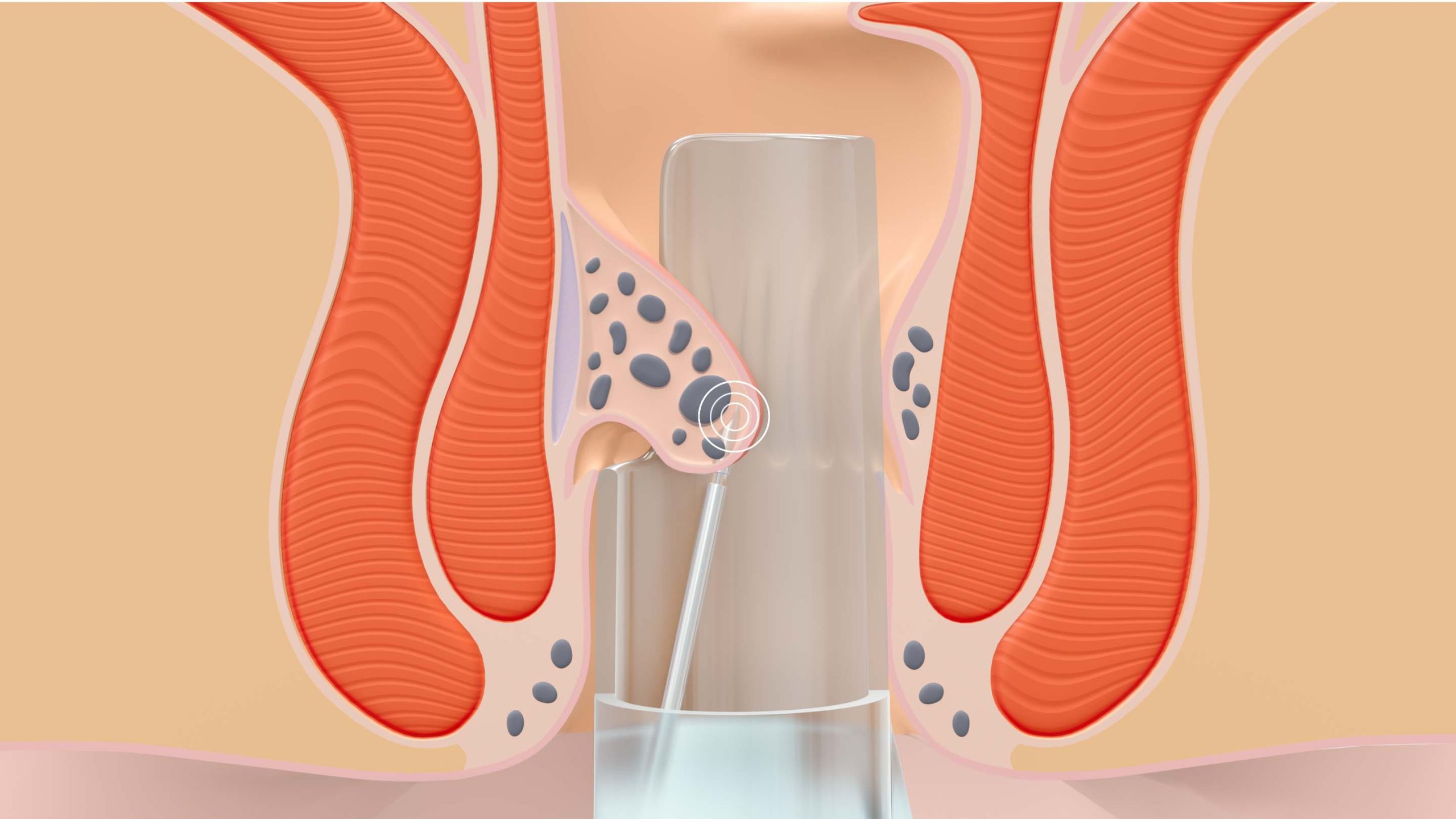
Foam endosclerosis. A sclerosing foam injected into the hemorrhoid makes it retract during the procedure itself. It is mainly indicated for grade I and II disease with bleeding, usually takes 10 to 20 minutes, requires no general anaesthetic and most patients describe it as painless. One session is often enough, two or three for more advanced grades. Read more about foam endosclerosis.
Radiofrequency. A controlled application of energy through a thin probe, which addresses both bleeding and prolapse. It is indicated for selected grade II and III cases with reducible prolapse and takes 15 to 30 minutes. Read more about radiofrequency.
Rubber band ligation. A small band placed at the base of the hemorrhoid, often combined with endosclerosis for grade II and III disease.
Surgery. Classic hemorrhoidectomy remains the right answer for a minority of advanced cases that are not suitable for minimally invasive techniques. When it is needed, the specialist will say so clearly and explain why.
After endosclerosis or radiofrequency you return to work and normal activities the same day. At Palazzo Manzoni the specialist who sees you is the same one who performs the procedure. You will find all the options on our hemorrhoid treatment page.
Did you know? The rubber band for hemorrhoids is more than sixty years old. As early as 1963 the surgeon J. Barron described rubber band ligation of internal hemorrhoids carried out in the outpatient clinic. The classic Milligan and Morgan operation is older still: it was described in 1937.
After treatment: why remedies still matter
Treatment closes the diseased hemorrhoid, but it does not change the habits that encouraged the problem. If constipation, low fibre and inactivity stay the same, a recurrence is possible. That is why the remedies above do not retire: they become your prevention.
In the days after the procedure, pay attention to bowel regularity and hydration and, if needed, take a mild painkiller. It is best to postpone intense exercise and long flights for a few days. A follow-up is booked at the agreed interval and, if further sessions are needed, they are planned four to six weeks apart.
Frequently asked questions
Do hemorrhoids go away on their own with natural remedies?
Mild episodes can improve with fibre, water, exercise and better toilet habits. If bleeding keeps recurring or a prolapse appears, though, the problem tends to come back: in these cases a proctology consultation to grade the condition is worthwhile.
Do creams cure hemorrhoids?
No. Creams and supplements, on medical advice, can ease flare-ups, but they do not close the dilated hemorrhoid. If you find yourself using them often, it is time to consider treatment.
When should I see a doctor about hemorrhoids?
When bleeding recurs, when a prolapse appears, when pain is sudden and severe, or when symptoms return despite good habits. Rectal bleeding should always be assessed by a doctor in any case, because it can have other causes.
Is outpatient hemorrhoid treatment painful?
Foam endosclerosis requires no general anaesthetic and most patients describe it as painless. Radiofrequency is also well tolerated. In both cases you return to normal activities the same day.
Do I need a referral for a proctology consultation?
No. At Palazzo Manzoni, Via dei Mille 14 in Brescia, you can book a proctology consultation directly by phone on +39 030 294 2437, by email or online.
If you have been living with hemorrhoids for a while and remedies are no longer enough, the right next step is a consultation. At the Vascular Surgery and Phlebology department of Istituto Chirurgico Palazzo Manzoni in Brescia, Prof. Edoardo Cervi grades the condition and proposes the treatment best suited to your case: you can book a proctology consultation online or by phone on +39 030 294 2437.