
Poor Night Vision When Driving: causes and when to worry
05.10.2026
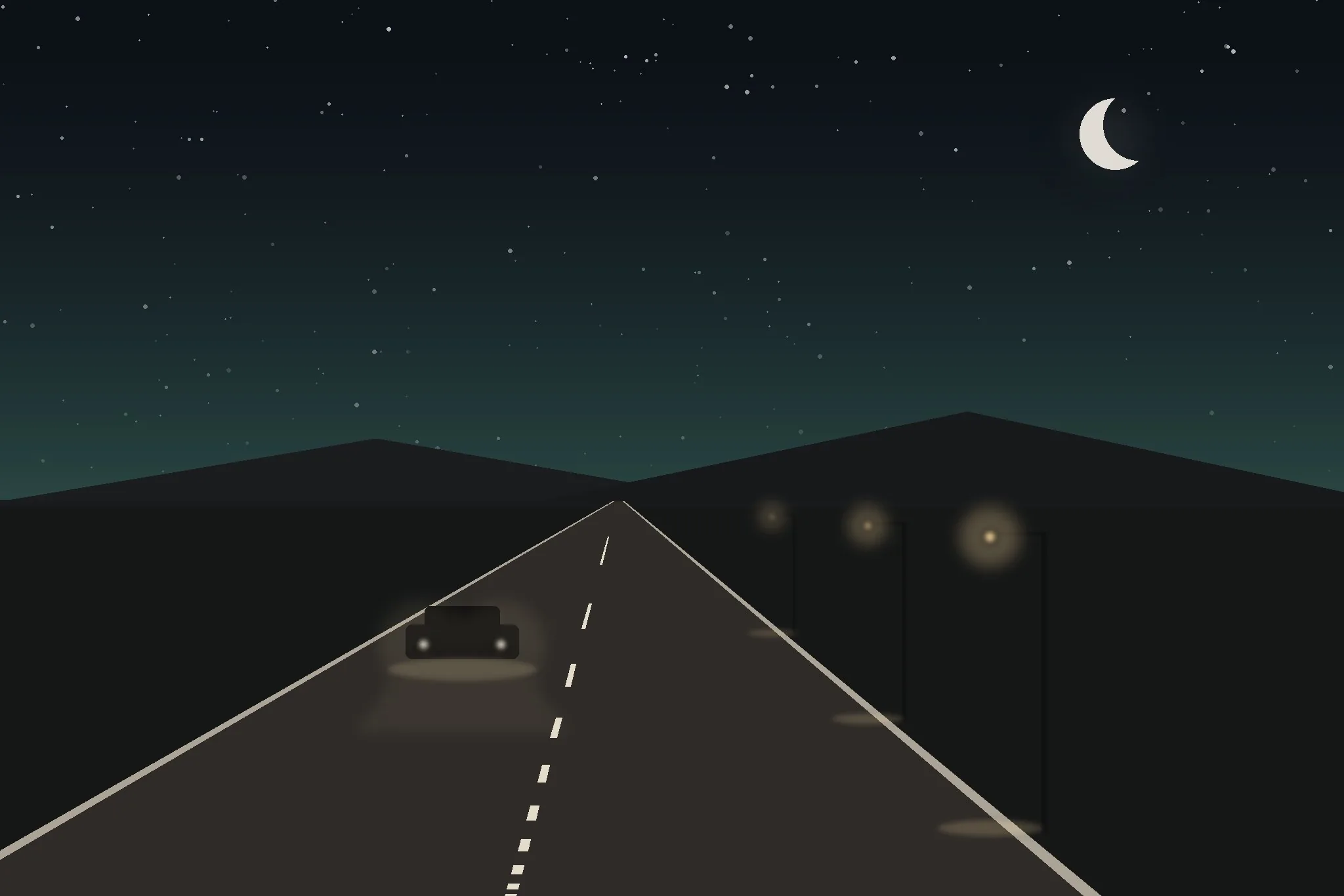
As autumn sets in, the days grow shorter and many of us find ourselves driving at dusk or after dark far more often. This is exactly when many patients notice something that went unnoticed in summer: oncoming headlights that dazzle more than they used to, halos around street lamps, road signs that look less sharp in the rain.
Seeing somewhat less well in the dark is, within limits, perfectly normal: the human eye is simply not designed to perform at its best in low light. When the difficulty increases over time, however, or makes night driving tiring and unsafe, it may signal an uncorrected visual defect or an eye condition that deserves a specialist assessment.
In this article we look at why vision worsens at night, the most frequent causes of reduced night vision, the warning signs you should not overlook and what can actually be done.
Why we see worse in the dark: what happens inside the eye
When light fades, the pupil widens to let more of it in. This adaptation comes at an optical cost: with a larger pupil, aberrations increase — small imperfections in the eye’s optical system that are negligible in daylight but can slightly blur images in the dark. Some people also develop a mild “night myopia”, which makes signs and distant shapes less distinct precisely when lighting is poor.
The retina also switches to a different set of cells: at night it relies mainly on rods, photoreceptors that are highly sensitive to light but poor at resolving fine detail and colour. Contrast sensitivity drops and recovery times after glare become longer, more noticeably as the years go by. Seeing worse in the dark is therefore partly physiological: the point is recognising when the difficulty goes beyond this natural threshold.
Did you know?
When you move from a brightly lit environment into darkness, the cones recover their sensitivity within a few minutes, while the rods — the cells responsible for night vision — can take up to about half an hour to approach their maximum sensitivity. That is why, turning onto a dark road at night after a brightly lit service station, you may feel almost unable to see for a few moments.
Source: Webvision, Moran Eye Center – Light and Dark Adaptation
The most common causes of difficulty driving at night
Uncorrected or undercorrected visual defects
Mild myopia or astigmatism can go unnoticed during the day, when a narrow pupil “masks” the defect, and show up in the dark as doubled headlights, light streaks and lettering that is hard to read. The same applies to glasses whose prescription is out of date. Visual defects are assessed with a simple refraction test, which is worth repeating periodically.
Early cataract
A clouding crystalline lens does not just reduce sharpness: it scatters light inside the eye. The result is halos around headlights and street lamps and more intense, longer-lasting glare. It is not unusual for night driving to be the first situation in which an early cataract makes itself felt, even when daytime vision still seems satisfactory. When the opacity interferes with everyday activities, your ophthalmologist may discuss cataract surgery.
Dry eye and an unstable tear film
The tear film is the first “lens” light passes through. When it is unstable, the ocular surface becomes irregular and light is scattered: vision may fluctuate and light sources appear smeared or fringed. The problem tends to worsen in the evening, after long hours at a screen and with the heating on. Dry eye treatment starts with identifying the underlying cause.
Other factors also play a part: with age the pupil dilates less and less light reaches the retina; some medicines can increase glare or reduce tear production; rarer retinal conditions affecting night vision are ruled out by the ophthalmologist during the examination of the back of the eye.
Did you know?
The eyes of cats, dogs and deer seem to “glow” when caught in the headlights thanks to the tapetum lucidum, a reflective layer behind the retina that bounces light back to the photoreceptors, giving them a second chance to capture it. The human eye has no such layer: it is one of the reasons many animals see far better in the dark than we do.
Warning signs you should not ignore
Some red flags deserve an assessment without delay:
- intense or prolonged dazzle after meeting oncoming headlights;
- halos or rings of light around street lamps and traffic lights;
- vision at dusk that has worsened over recent months;
- needing more and more light to read or make out details;
- double or ghosted vision at night, even with glasses on.
None of these signs points to a precise diagnosis on its own, but each of them justifies a check-up: most causes, caught early, can be corrected or treated effectively.
What can be done: from the eye examination to practical habits
The starting point is a complete eye examination: accurate refraction testing, examination of the anterior segment and of the back of the eye and, where indicated, tear film tests make it possible to tell a simple prescription update from an early cataract or an ocular surface disorder.
Depending on the cause, the solutions differ: updated lenses, ideally with a good anti-reflective coating; treatment of dry eye; and, when cataract is responsible for the symptoms, replacement of the crystalline lens with an intraocular lens, to be discussed with the surgeon.
Alongside medical care, small habits help too: a windscreen and glasses that are clean inside and out, properly adjusted headlights, shifting your gaze towards the edge of the lane when meeting other vehicles, regular breaks on long journeys and moderate dashboard brightness.
Frequently asked questions
Is it normal to see worse at night as you get older?
Partly, yes: the pupil dilates less, the eye’s optical media become less transparent and adaptation times get longer. A marked or rapid deterioration, however, should not be put down to age without an eye examination.
Do halos around lights always mean cataract?
No. Halos and glare can also result from uncorrected visual defects, dry eye or other conditions of the cornea. It is the overall picture from the examination that tells the different causes apart.
Can I keep driving if I see poorly at night?
Caution comes first: minimum visual standards apply to driving, and reduced night vision increases fatigue and reaction times. If you notice difficulties, limit driving after dark until the cause has been clarified by a specialist assessment.
At the Ophthalmology department of Istituto Chirurgico Palazzo Manzoni in Brescia, Via dei Mille 14, you can undergo a complete eye examination with advanced diagnostic equipment, to identify the cause of your night vision difficulties and plan the most suitable path forward. You can book by phone on 030 294 2437.


