
Regenerative Medicine · Orthopaedics
Adipose tissue and mesenchymal cells: “stem cells” for the knee, without the myths.
People often talk about “stem cells for osteoarthritis”. In reality, the subject is more complex: microfragmented adipose tissue, stromal vascular fraction and laboratory-cultured mesenchymal cells are different preparations, with different production methods, biological characteristics and rules.
At Palazzo Manzoni, adipose tissue is harvested by Dr. Stefano Di Nonno and injected into the joint or around the tendons by Dr. Claudio Gilardoni, under ultrasound guidance, in the same session. Here you will find what we really know today, including the limitations.
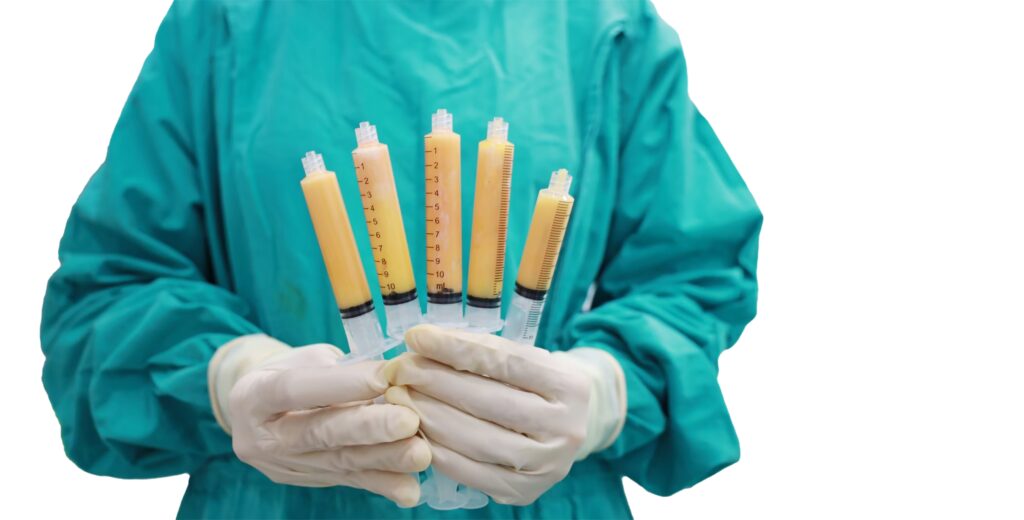
Same session
Harvesting, preparation and injection in the same procedure
Ultrasound-guided
The tissue is injected under ultrasound guidance
Two specialists
One harvests the fat, the other treats the joint
Second line
To be considered after other non-surgical treatments
Why Adipose Tissue
Fat is not just an energy reserve.
Adipose tissue contains blood vessels, extracellular matrix and various cell populations, including cells with mesenchymal characteristics. It is an easily accessible source: it is harvested with a small liposuction, usually from the abdomen or thighs.
These cells, called mesenchymal stromal cells (MSCs), are of interest because of their ability to produce biologically active molecules. Their possible role seems to depend not so much on their ability to turn into other types of cell as on their paracrine activity: they communicate with neighbouring cells through growth factors, cytokines and other molecules, modulating inflammation. This is why they have been compared to the conductor of an orchestra: they do not play in place of the others, but coordinate the cells of the joint through their messages, carried partly by tiny vesicles called exosomes.
The aim, therefore, is not to “inject cells that become cartilage”, but to try to modify the biological environment of the joint in a favourable way.
Did you know?
In 2001, a team at the University of California, Los Angeles showed that fat harvested by liposuction contains cells that, in the laboratory, can become fat, cartilage, muscle and bone cells. The researchers were looking for an alternative to bone marrow: a source that could be obtained in large quantities, under local anaesthetic and with little discomfort.
Different Preparations
Let’s not call everything “stem cells”
The harvested material can be processed in different ways. These procedures are not equivalent, and it is not correct to group them all under the generic label of “stem cell therapy”.
The rules differ too: under European law, cells or tissues become advanced therapy medicinal products, requiring specific authorisations, if they are substantially manipulated, for example multiplied in the laboratory, or if they are used for a function different from the one they had in the tissue of origin.

Did you know?
One of the best-known technologies for obtaining microfragmented adipose tissue originated in Italy, in Milan: it was patented in 2010 and has been available for clinical use since 2013. The fat is washed and gradually reduced into fragments of about 0.3-0.8 millimetres. The description comes from its inventors themselves.
01
Microfragmented adipose tissue
The fat is washed and mechanically reduced into small fragments, preserving the cellular and structural components of the tissue. It is prepared in the same session.
02
Stromal vascular fraction (SVF)
The cells are separated from the tissue, usually by enzymatic digestion: for the European Medicines Agency, this is, as a rule, a substantial manipulation. SVF can also be obtained mechanically, by filtration and centrifugation, which preserves part of the matrix and remains a minimal manipulation: this is the method we use at Palazzo Manzoni.
03
Cultured mesenchymal cells
Cells isolated and multiplied in the laboratory: they are advanced therapy medicinal products and are used mainly in clinical trials.
04
Bone marrow concentrate
Another source of stromal cells, harvested from the pelvis: here too, the evidence is still evolving.
05
A question of words
The International Society for Cell & Gene Therapy (ISCT) recommends saying “mesenchymal stromal cells” and using “stem” only when stemness has been demonstrated.
What the Research Says
Adipose tissue and the knee: conflicting results, evidence still weak
The use in the knee of preparations derived from adipose tissue is being studied to reduce pain, improve function and modulate some of the processes of osteoarthritis. However, the research is very heterogeneous: techniques, products, doses and patient selection criteria vary.
→Versus placebo
In a study of 120 patients followed for 2 years, all of whom underwent liposuction but only half of whom were treated with their own microfragmented fat, the two groups improved to a similar extent. Barfod 2025
→Versus PRP
A meta-analysis of 6 randomised studies found similar results for pain, function and safety up to 24 months, with a small advantage for adipose tissue at 6 months. Park 2025
→Stromal vascular fraction
In 9 randomised studies it gave better results than hyaluronic acid and saline, but not consistently when compared with cortisone. Han 2025
→Cartilage
A review of 19 randomised studies reports some favourable signals on MRI, but no consistent regeneration of cartilage. Batista 2026
→The guidelines
The 2025 European ESSKA-ORBIT consensus considers cell therapies a second-line option, after other non-surgical treatments have failed; the highest-quality guidelines advise against “stem cell” injections. de Girolamo 2025; Gibbs 2023
For this reason, at Palazzo Manzoni adipose tissue is not the first option we suggest: we consider it in selected cases, explaining clearly what it can and cannot do.
The Right Questions
Do mesenchymal cells make cartilage grow back?
This is the point that most needs clarity. Mesenchymal cells have very interesting biological characteristics, and laboratory studies show a possible role in protecting and repairing tissues. But today it is not possible to promise that an injection of adipose tissue will make cartilage worn away by osteoarthritis grow back: MRI studies give inconsistent results.
Any benefit obtained (less pain and better function) should therefore not be interpreted as proof that cartilage has been rebuilt.
And between adipose tissue and PRP, which is “more powerful”? Neither, in principle. PRP comes from the blood and concentrates platelets and the molecules they release; adipose preparations have a more complex structure, with matrix and stromal cells. The choice depends on the condition, its severity, your individual characteristics and the evidence available for that indication.
Did you know?
The biologist who popularised the term “mesenchymal stem cells” in 1991, Arnold Caplan, proposed in 2017 renaming them Medicinal Signaling Cells and warned that the word “stem” leads patients to imagine cells that turn into new tissue. In his view, the new tissue is built by the patient’s own cells, stimulated by the signals these cells release.
Who Takes Care of You
Two specialists,
a single session
Treatment with adipose tissue combines two areas of expertise: harvesting and preparing the fat, and the ultrasound-guided injection into the joint. The first consultation is with the orthopaedic specialist, who decides whether the treatment is indicated.
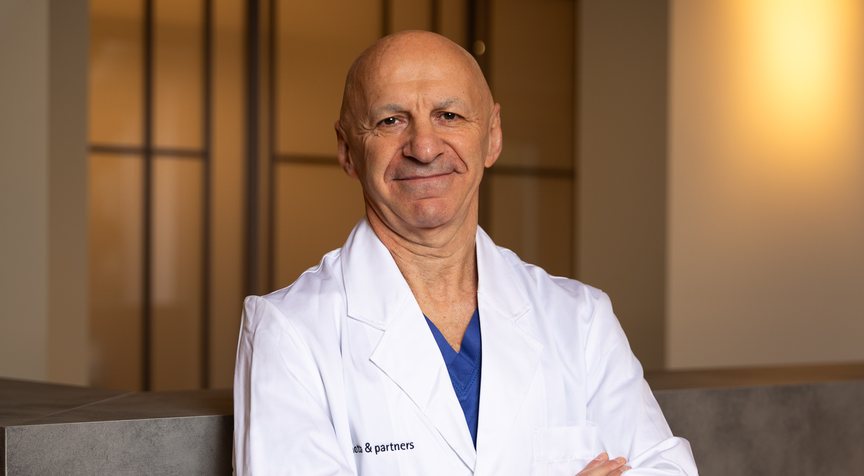
Dr. Claudio Gilardoni
Specialist in Orthopaedics and Traumatology · indication and ultrasound-guided injection into the joint or around the tendons.

Dr. Stefano Di Nonno
Specialist in General Surgery, with a master’s degree in Aesthetic Surgery · harvesting and preparation of adipose tissue.
Your Journey
How treatment with adipose tissue works
Step 01
The orthopaedic consultation
Dr. Gilardoni assesses your symptoms, tests and previous treatments, and establishes whether adipose tissue is a reasonable option or whether there are better routes.
Step 02
The plan
We explain what to expect, the alternatives, the limitations of the evidence and how to prepare for the procedure.
Step 03
The harvest
In the operating theatre, without hospital admission, under light sedation and local anaesthetic, Dr. Di Nonno uses a micro-cannula, through an incision of a few millimetres, to harvest 50 to 200 cc of fat: usually from the abdomen, flanks, outer thighs or inner thighs.
Step 04
Preparation and injection
The fat is processed in the same session with a single-use, closed-system medical device, using only filtration and gentle centrifugation, without enzymes or laboratory steps: the result is adipose tissue rich in stromal vascular fraction, with minimal manipulation. It is then injected under ultrasound guidance into the joint, into or around the tendons, or into the muscle. Several sites can be treated together; since 2021 PRP has been added to the adipose tissue as a support and activator.
Step 05
Rehabilitation and follow-up
The procedure takes about an hour: after about 30 minutes of observation you go home, and you can usually return to daily activities within 2 days. Then advice on weight-bearing, exercise and scheduled follow-up visits to monitor pain and function over the following months.
Frequently Asked Questions
Frequently asked questions
about adipose tissue and mesenchymal cells
What are mesenchymal cells?
They are cells found in various tissues, including fat and bone marrow, that in the laboratory can turn into bone, fat and cartilage cells, and that release many molecules capable of modulating inflammation and influencing neighbouring cells. Today the preferred term is mesenchymal stromal cells.
Do stem cells for the knee work?
Some studies show improvements in pain and function in selected patients, but the research is heterogeneous: in a placebo-controlled study, microfragmented adipose tissue did not outperform saline. The European consensus considers them a second-line option, after other non-surgical treatments have failed.
How is adipose tissue harvested?
With a small liposuction, through an incision of a few millimetres and a micro-cannula: usually 50 to 200 cc of fat are harvested from the abdomen, flanks, outer thighs or inner thighs. The harvest is performed in the operating theatre, without hospital admission, under light sedation and local anaesthetic, and the tissue is prepared and injected in the same session.
Is the treatment painful?
Harvesting and injection are performed under local anaesthetic, possibly with sedation tailored to the individual case. In the following days there may be some discomfort and bruising at the harvest site, and pain or swelling in the treated joint, which are generally short-lived.
Is adipose tissue or PRP better?
They are different preparations, and neither is more powerful in principle. In a meta-analysis of 6 studies, the results were similar up to 24 months. The choice depends on the problem, its severity and your individual characteristics, and is made during the consultation.
Does adipose tissue make cartilage grow back?
This has not been proven. MRI studies give inconsistent results, and none shows consistent regeneration of cartilage. The possible benefit concerns pain and function.
Are cell therapies regulated?
Yes. Under European law, cells or tissues that are substantially manipulated, for example multiplied in the laboratory, or used for a function different from their original one are advanced therapy medicinal products and require specific authorisations. Palazzo Manzoni performs treatments with adipose tissue, including in joints and the TMJ, in compliance with the required authorisations. At the consultation we explain which preparation we would use in your case, how it is obtained and why.
How long does the procedure take and when can I return to normal activities?
About an hour, as an outpatient or day-hospital procedure, without hospital admission. After about 30 minutes of observation you go home, and you can usually resume normal activities within 2 days. Sport and heavier loads are reintroduced gradually, following Dr. Gilardoni’s advice.
Can several joints be treated in the same session?
Yes. With a single fat harvest several sites can be treated, for example both knees, or a joint and a tendon. The tissue is injected into the joint, into or around the tendons or into the muscle, under ultrasound guidance when needed.
When are results visible and how long do they last?
Improvement is gradual. In Dr. Gilardoni’s experience it is usually noticeable after about 6 months, often around 3 months since PRP has been added to the fat, and lasts on average 3-5 years, sometimes longer. It depends on the indication, age and severity of the lesion, and the response varies greatly from person to person. Studies that follow patients for that long are still few: at the consultation we explain what is realistic to expect in your case.
How much does treatment with adipose tissue cost?
The cost covers harvesting, preparation and injection, and depends on the case. After the orthopaedic consultation you will receive a detailed written quote.
Take the Next Step
Your next step starts
with a conversation
At Palazzo Manzoni in Brescia, every consultation is personal, unhurried, and designed to give you clarity about your next step.
Address
Via dei Mille 14, 25122 Brescia, Italia
Phone
Hours
Mon-Fri 8:30-18:30 · Sat 9:00-13:00
01
Get in touch
Call, email, WhatsApp, or book online.
02
Meet your specialist
A personal consultation to understand your situation.
03
Your plan, your pace
Together you decide the best path forward.
Content reviewed by Dr. Claudio Gilardoni and Dr. Stefano Di Nonno.